Friday, July 20, 2012

Visions from a Visionary

What would happen if we as a society made it more of a habit to follow true visionaries?  Dictionary.com defines a visionary as "given to or characterized by fanciful, not presently workable, or unpractical ideas, views, or schemes."  Could we make an effort to make unpractical ideas into practical ones? 

A number of years ago a mural emerged on a two-story building on Fortification St. in the Belhaven neighborhood of Jackson.  It was the talk of the town.  Some people were outraged, others were enthused.  It was a unique montage of Southwestern and Native American style imagery gradually covering the entire south and west sides of the building.  One of the most impressive images in the mural was a Native American face stretching the entire two stories on the west facade.  Unfortunately, that side was painted over.  The south facade mural remains.  The mural was painted by a local excentric artist named Patrick Grogan whom I believe was living in the building at the time.

As voices were heard complaining that Belhaven is an historic district and that the mural shouldn't be allowed I wondered what would happen if we followed Patrick's lead.  What if the neighborhood embraced and even encouraged the idea of artists painting murals on the facades of Fortification properties, most of which needed face lifts anyway? That with the upcoming revitalization of Fortification St. could turn that area into an international tourist destination.  Can you envision it?

Many years have passed since the mural was done, but Patrick has not stopped painting.  There was recently an extensive exhibition of his work at the MS Arts Center.   A majority of the work followed the Southwestern aesthetic of the mural.  It is at the same time bizarre, beautiful and intriguing. 

His work was showing at the same time as two other young painters, Greg Gandy who works at the North Midtown Arts Center, and Tristan Barlow.  Their work complemented each other's well but was not helped by the deteriorating conditions of the MS Arts Center galleries. 

Here is a small sampling of the work...

Greg Gandy
"Woman"


Greg Gandy
"Clippin a Leaf"


Greg Gandy
"Sad Friends"


Patrick Grogan
House on Fortification St.


Patrick Grogan
untitled


Patrick Grogan
"Hawk"


Patrick Grogan
"Full Spread"


Patrick Grogan
"Jesus in the Sky with Diamonds"


Patrick Grogan
untitled


Tristan Barlow
"Saint"


Tristan Barlow
"Still life"


Thursday, January 26, 2012

Arts and Crafts... what's the difference?

There is a remarkable show of quilts hanging right now at the Mississippi Craft Center in Ridgeland by the late Gwendolyn Magee.  I was only vaguely familiar with her work prior to visiting the show recently, and I never had the opportunity to meet her before she passed away last year.  I was primarily familiar with her work in the permanent collection at the Mississippi Museum of Art.  Her work often attacks images of race and injustice head-on like a visual steam train of which you cannot get out of the way.  Narratives of slaves with bloody slashes on their backs, one pooring arsenic in her master's supper, a man hiding in the shadows of his home defending it from those burning a cross on his lawn,  even the death around the New Orleans Superdome after hurricane Katrina.  She successfully avoids being trite and sentimental in her narratives.  The amazingly beautiful craftsmanship of the quilting juxtaposed with the hard core imagery is as powerful as any art should expect to be.  

Fortunately she gives us some relief from the emotionally charged narrative work and produces more traditional patchwork quilts as well, with a superb delicacy and uniqueness.  However, it was the narratives that lingered with me.  They are not images you might expect to come across in an environment like a craft center. So it got my mind to wondering, what is a craft?  Gwen's work hangs in both the Art museum, and the Craft center, so is there a difference?  Is there a fine line, a fuzzy line, or no line at all?  

I began the search for an answer by trying to figure out what the Craftsmen's Guild of MS uses as a criteria for acceptance.  It seems pretty open ended.  Primarily the work has to be three dimensional, hand made, and show a level of mastery of the material.  Apparently there was a little question at first about Roy Adkins' mixed media pieces.  Roy is a local photographer and the pieces look like work you would find in a typical art gallery, but when he explained that in his work pieces of canvas were sewn together then his energetic pieces were fully embraced and welcomed into the fold.  

I soon realized that the Craftsmen's Guild and the Craft Center were not trying to define what a craft is or isn't, they are just trying to define the culture of their own organization.  Dictionary.com says that a craft is "an arttrade, or occupation requiring special skill, especially manual skill".  Art itself can hardly be defined at all other than something created by a human being wherein if he calls it art it must be (sorry, what the elephants do isn't art).  Most art requires some sort of craftsmanship, though not all.  Stretching a canvas, sizing it, priming it, even painting it is all craft.  

So my answer is no, there is no difference between art and craft.  Some work rises to the level of fine art, some doesn't. There has to be a difference in quality of art, but that is a whole other discussion.  Art is wonderfully undefinable and will always continue to challenge, excite, entertain, and fulfill us as long as there are living breathing people on this Earth with the God-given gift of creativity.

 Gwen Magee
"86 Lashes to Go"

Gwen Magee
"Full of the Faith"

Gwen Magee
"Over a Way That with Tears Has Been Watered"

Gwen Magee
"Yassa Massa, Yo Dinner Won't Neva Be Late No Mo!"

Gwen Magee
"Jewel Fire"

Gwen Magee
"Not Tonight"


Roy Adkins

Roy Adkins

Wednesday, January 4, 2012

Art in the back yard part 2

This past summer I put almost everything on hold to focus on building myself a new studio.  This blog was put on what was supposed to be a three month break and it turned into a six month hiatus.  I'm not apologizing though, and won't bore you with excuses.  

What I am sorry about is how few art shows I have actually visited lately.  I have missed the opportunity to write about and share thoughts on some really nice shows like the Clarence Morgan show at the MSU School of Architecture and completely missed seeing shows that I wanted to check out like the Dan Piersol and Maureen Donnelly exhibition at Fischer Galleries.  I did make Richard Kelso's annual December show at Fischer, and you may still be able to catch some of it if you're lucky.  

Clarence Morgan

Dan Piersol

So I've decided that I will return to the passions of my children and their love of Andy Goldsworthy.  previous post  At some point early this past summer my 5 year old and soon to be 4 year old asked to watch the movie about "the guy who makes things".  Could any of us ask for a better title than that?  The dreams and inspiration after watching Rivers and Tides are evident in their eyes, and I am right there with them.  It never fails that after watching this documentary they are ready to create.  My son decided that we should make a stone arch like the ones Andy makes.  Problem number 1: we don't live in a rocky environment.  Problem number 2: that sounds like a lot of work, and I am going to have to do it all myself.  Problem number 1 was solved when I found some chunks of broken concrete.  Problem number 2 couldn't be solved.  So here we go...


The first arch...


 collapsed...

he was devastated...

the second arch...

collapsed...

as did the third and maybe the fourth, I can't remember now how many of them I made.  In the documentary Andy talks about getting to know the stone as you are working with it.  There is a lot of truth to that, and finally...


we (I) did it.

But the story doesn't end there.  In the documentary Andy says "the very thing that brings the work to life is what will cause its death".  In his case it is nature, and in my case it is a 5 year old boy with a soccer ball.  Apparently after two weeks our stone arch began to look more like a soccer goal than a piece of artwork.  He was heartbroken though, and there is probably a good lesson in there about how we become too comfortable and careless with things around us that we care for... be it art, religion, relationships, or whatever.  

In order to keep this blog post from being completely nostalgic I wanted to share some new thoughts on Andy's work.  There is an obvious connection between Andy's work and the environmental or land art in the United States from the late 60's and early 70's, but his aesthetic seems quite different from most Westerners.  During the same time period there was an art movement in Japan called the Mono-ha.  This movement was also environmental in nature, but the work has that certain something that Japanese work has.  A simple beauty and elegance that is indicative of the culture.  This overall Japanese aesthetic is apparently derived from traditional tea ceremonies and is called Wabi-Sabi.  In Leonard Koren's book Wabi-Sabi for Artists, Designers, Poets and Philosophers, he says that Wabi-Sabi is "a beauty of things imperfect, impermanent, and incomplete.  It is a beauty of things modest and humble.  It is a beauty of things unconventional."  I think that Andy Goldsworthy may be Scottish, but he is really Japanese at heart. 


Thursday, July 14, 2011

Joe Perkins

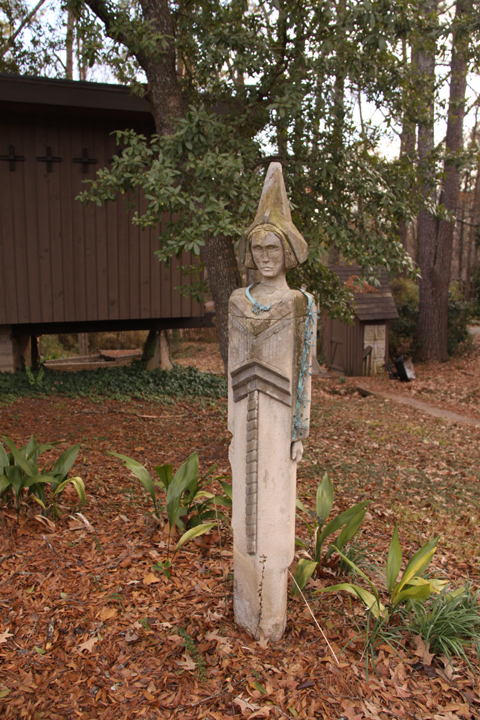
Retired architect Joe Perkins has creativity pumping through his veins with enough vigor to make the rest of us jealous.  With architecture inspired by Frank Lloyd Wright, paintings inspired by Gustav Klimt, and sculpture inspired by ancient Aztec culture he blends influence with his own unique vision.  You can read about my recent introduction to this impressive artist in the July issue of Jackson's Portico Magazine.  


Also, some of Joe's work is now on display at the Madison County Public Library until October 1, 2011.  Here are some images of Joe, and a few of his masterpieces...


Wednesday, May 4, 2011

Culture as a controlled substance


I was on the phone the other day with a buddy of mine from New York City, and he asked me if I have had any problems teaching figure drawing down here.  He sees the South through the media's lens as an ultra conservative place that might not be open to such a course of study.  I proudly told him that him that I have had nothing but encouragement and support since beginning the classes two years ago.  It is a class which demands maturity and seriousness.  I had some trouble back in undergraduate school when I wanted to study the human figure (previous post discussing this), but not in this more professional setting.  While on the phone with him I had another call come in.  This call was from the city of Madison.

Several weeks before, I was asked to teach a figure drawing class in Madison for a group of ladies that often paint together.  We were going to be able to use someone's painting studio in the Madison Cultural Center, which is the old school at the corner of hwy 463 and hwy 51.  The director of the facility approved it, and the space was absolutely perfect.  

After two classes, the mayor of Madison found out that we were drawing nude models and kicked us out of the space.  The city of Ridgeland has welcomed us with open arms, so everything has worked out well, but it just caused me to consider the culture of Madison that is being created.  Now I will say that we were in a public building and that she had complete authority to do what she did.  I have also found out that she has kicked out yoga classes and karate classes.  I also believe that she is sincerely trying to create a culture based on aesthetic principles and positive social influences.  

Culture is defined as "the quality in a person or society that arises from a concern for what is regarded as excellent in arts, letters, manners, scholarly pursuits, etc."  By enforcing extremely strict building codes, signage codes, and keeping out classes the mayor deems inappropriate for a cultural center she is ultimately suppressing creativity, artistic expression, and the ability of the residents of Madison to create their own culture.  

I am not necessarily trying to persuade anyone of my opinion in writing this, but I believe that it is a vitally important topic to be discussed. Not just about Madison, Mississippi, but about every municipality.  As citizens we should be concerned with how much the arts are supported or suppressed.  It is the artistic vision and excellence of the people that creates a beautiful and fulfilling place to live.  

Wednesday, April 20, 2011

Figment Jackson

Figment Jackson looks like it will be an interesting test of Jackson's interest in participatory and experimental art.  They are still looking for projects for the weekend.  Check out their website http://jackson.figmentproject.org/ and sign up if you have an idea.  I saw that Megan Prosper is resurrecting  her senior exhibit, which I posted about recently.  If you missed her show at Belhaven here is another chance to be moved and inspired.  Local photographer Rachel Kabukala also did a blog post about Megan's show, and did a much better job than I did of photographing it.  

Saturday, April 9, 2011

Southern Gothic

I have a solo show up right now through the end of the month at Gallery 119 in downtown Jackson.   It is titled Southern Gothic and it is a continuation of my visual exploration of the use of contemporary realism and narrative in paintings and drawings.  This particular approach to my art began with my exhibition "Songs of Innocence / Songs of Experience" in the Spring of 2010.  

I am also continuing the use of handmade paper as a support for my oil paintings.  The folds, ripples, and tears allow the paper to become its own character  in the narrative.  The composition I apply to the paper itself comes from a curiosity of how the personality of a piece can shift as multiple sheets of paper are put together in various ways.  For example, in the painting "Fearmonger" I used random scraps of torn paper collaged together in a design that contrasts with the simplicity and symmetry of the painting itself.  Another example is the painting "Patchwork".  I wove together strips of paper to create a grid-like pattern.  A border was put around the woven paper to give the feeling of a quilt or blanket.  My use of traditional painting techniques on a nontraditional surface encourages the viewer to consider that which the painting is done on.  It is an important and much overlooked element of the final painting. 

The title of this exhibition refers to a genre found in many art forms where the work focuses on life particular to the American South.  Often used to describe the literary work of William Faulkner, the photography of Sally Mann, and the music of Jim White; this subject explores southern culture through social observations and commentary, without being moralistically critical.  Southern Gothic work usually uses dark and mysterious content to push its broader themes, however, what is disturbing to one may be innocent to another.  The paintings "The Target" and "Southern Gothic" are good examples of images that could be read either way depending on the viewers personal perspective and experiences.  My attempt at this genre is simply an honest study of my life in and my perceptions of life in the South.  

Here is a selection of the work from the show... 

Expecting the Fall
Oil on handmade paper
22"x28"


Fearmonger
Oil on collaged handmade paper
24"x30"


Patchwork
Oil on woven handmade paper
31"x38"


Self Portrait
Oil on handmade paper
30"x60"


Southern Gothic
Oil on handmade paper
22"x28"


The Target
Oil on handmade paper
30"x60"


Tree Removal 4 (series of 6)
Ink on paper
5.5"x8" 


Tree Surgeon
Silverpoint on prepared paper
5.5"x5.5"